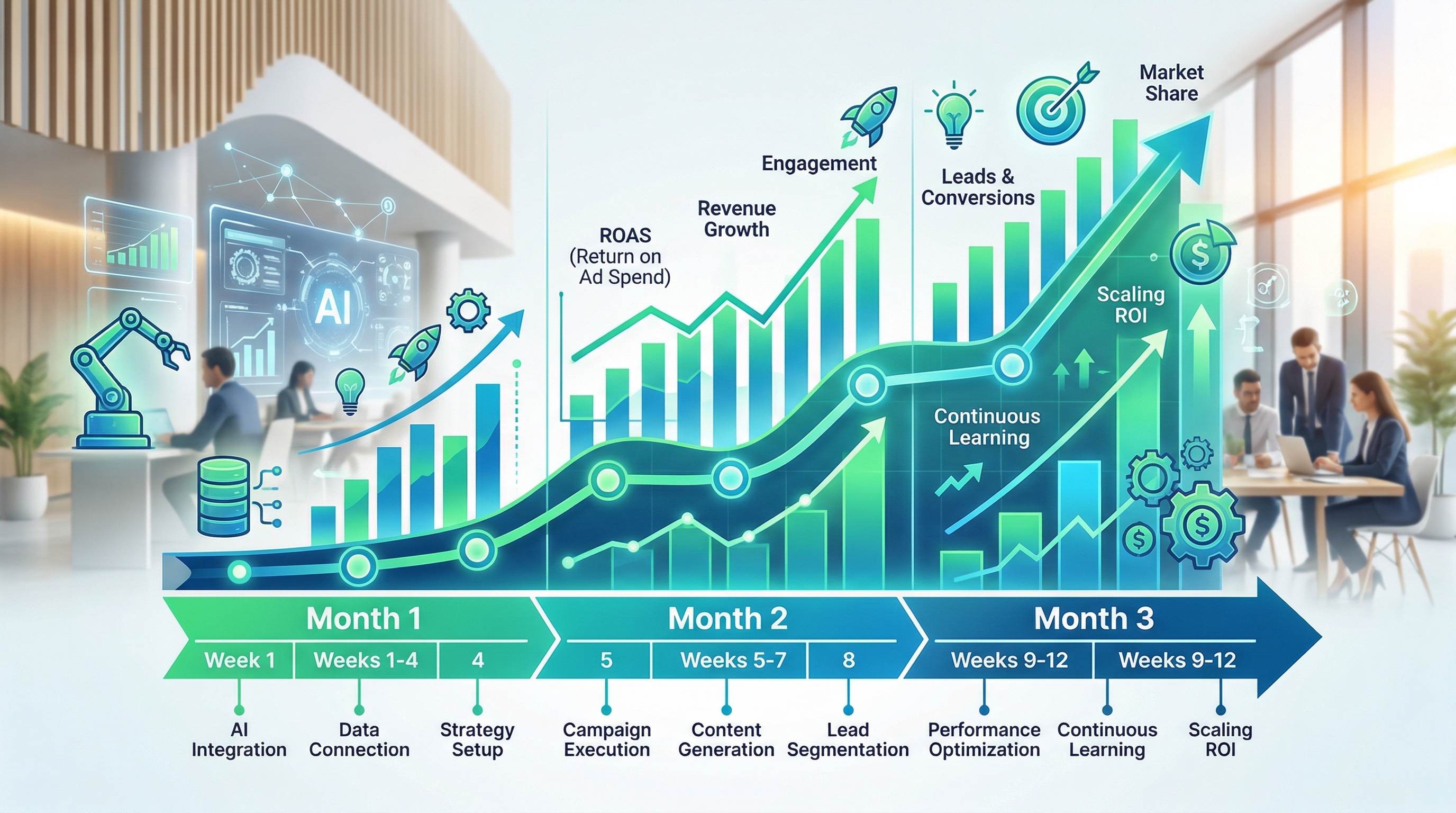
You've heard the pitch: deploy an AI marketing agent and your marketing runs itself. But what does that actually look like in practice?
No hype. No best-case-only numbers. Here's the honest, week-by-week reality of your first 90 days with an AI marketing agent — based on real client deployments.
Week 1: Foundation (Days 1–7)
What Happens
- Day 1: Agent deployed. Your business context, ICP, tone, and brand guidelines are configured. Social media accounts connected. Email domain verified.
- Days 2–3: SEO keyword audit completed. The agent identifies 20–30 high-intent keywords your buyers are searching for. Competitor content gap analysis runs automatically.
- Days 4–5: First 2 blog posts written and published. Google Indexing API submission sent. LinkedIn and Instagram posting begins.
- Days 6–7: CRM set up with your existing contacts imported. First cold email sequence drafted and submitted for your review.
What You Do
About 2 hours total. Review the keyword strategy, approve the first blog posts, check the email drafts. Give feedback on tone and messaging.
Results
Don't expect leads yet. Week 1 is about laying infrastructure. You'll have 2 blog posts live, social channels active, and email ready to deploy.
Week 2–3: Building Momentum (Days 8–21)
What Happens
- 4–6 more blog posts published (now 6–8 total, all SEO-optimized)
- Daily social media posts across LinkedIn, Instagram, and Facebook
- Cold email sequences begin sending to first batch of qualified prospects
- Google starts crawling and indexing your new content
- Social engagement begins — comments, profile views, connection requests
What You Do
About 30 minutes per week. Quick review of content queue, approve/edit any posts that need your voice, respond to any direct replies from prospects.
Results
First signs of life:
- Google Search Console shows impressions for your target keywords
- LinkedIn post views climbing from dozens to hundreds
- 1–3 cold email replies (even if they're "not right now" — that's data)
- Website traffic up 20–40% from baseline
Week 4–6: Early Traction (Days 22–42)
What Happens
- Blog posts now totaling 10–15, forming topical clusters around your core keywords
- Google rankings starting to appear — typically position 15–30 for medium-competition keywords
- Social media following growing organically
- Second and third cold email follow-up sequences sending automatically
- Agent begins A/B testing email subject lines based on open rate data
- Video content (Reels, Shorts) producing and publishing if enabled
What You Do
Still about 30 minutes per week. The agent has learned your preferences from early feedback and needs fewer corrections.
Results
- First organic search clicks from blog content
- 3–8 qualified email replies across all sequences
- LinkedIn profile views up 200–400%
- First inbound inquiries from content ("I read your blog post about…")
- Clear data on what messaging resonates and what doesn't
Week 7–9: Compounding (Days 43–63)
What Happens
This is where the flywheel effect becomes visible. The blog posts published in weeks 1–4 are now starting to rank and drive consistent traffic. Each new post reinforces the topical authority of existing posts.
- Blog library at 18–24 posts — genuine content moat forming
- Multiple posts ranking on Google page 1–2 for target keywords
- Social media engagement compounding — your posts get shown to wider audiences
- Email response rate improving as subject lines and messaging optimize
- Prospect pipeline actively tracked in CRM with automatic follow-ups
What You Do
20 minutes per week. At this point, the agent rarely needs corrections. You focus on responding to warm leads and having actual sales conversations.
Results
- 50–200 monthly organic visitors from SEO (depending on niche competitiveness)
- 10–20 qualified leads in pipeline from email + inbound combined
- Consistent daily social presence with growing audience
- First closed deal from an AI-generated lead (typical for this timeframe)
Week 10–13: System Maturity (Days 64–90)
What Happens
- 30+ blog posts forming a comprehensive content library
- SEO traffic growing 15–25% month-over-month
- Social channels established with consistent engagement
- Cold email hitting optimized sequences with proven subject lines and messaging
- Agent running fully autonomous — content creation, posting, outreach, follow-up, reporting
What You Do
15–20 minutes per week. Review the weekly performance report. Respond to inbound leads. That's it.
Results by Day 90
| Metric | Typical Range |
|---|---|
| Blog posts published | 28–36 |
| Social media posts | 180–270 |
| Emails sent | 200–500 |
| Monthly organic visitors | 100–500 |
| Qualified leads in pipeline | 15–40 |
| Email response rate | 3–8% |
| Your time invested (total) | 12–15 hours across all 90 days |
What About the Things That Can Go Wrong?
Honest assessment of risks and how they're managed:
Risk: Content quality doesn't match your voice
Reality: The first 2–3 blog posts often need edits. By week 3, the agent has calibrated to your tone and style. Most clients approve content with zero changes by month 2.
Risk: SEO takes too long
Reality: SEO is a 3–6 month play. An AI agent compresses the timeline by publishing more consistently than any human can, but Google still indexes on its own schedule. The key difference: the agent never stops publishing, so the compound curve starts sooner.
Risk: Low email response rates
Reality: Cold email response rates are typically 2–5% for well-targeted campaigns. The agent improves this over time through subject line testing and messaging optimization. The real advantage is volume and consistency — sending 50 personalized emails per week without any of your time.
Risk: Social media engagement is slow
Reality: Organic social growth takes 60–90 days to show meaningful traction. The agent's advantage is that it posts every single day, on every platform, without fail. Consistency is the single biggest predictor of social media success.
The Real ROI Math
Let's be conservative:
- Agent cost: $499/month × 3 months = $1,497
- Your time: 15 hours × $100/hour value = $1,500
- Total investment: ~$3,000
Conservative output after 90 days:
- 30 blog posts (would cost $6,000–$15,000 from freelancers)
- 200+ social media posts (would cost $3,000–$5,000)
- 300+ personalized emails sent (would cost $2,000–$4,000)
- SEO foundation with ranking keywords (ongoing compounding asset)
- 15–40 qualified leads in pipeline
If even one of those leads converts to a $5,000+ deal — which is typical for B2B services — the 90-day ROI is positive.
And unlike a one-time campaign, everything the agent built continues working: blog posts keep ranking, social profiles keep growing, email sequences keep sending.
Who Gets the Best Results?
Based on our data, the SMBs that see the strongest 90-day results share these traits:
- Clear ICP: They know exactly who their ideal customer is
- Service-based business: B2B services with $5K+ deal sizes see the fastest ROI
- Willing to review (briefly): 20 minutes/week of content review keeps quality high
- Patient with SEO: They understand that months 1–2 are investment, month 3+ is payoff
- No existing content: Ironically, starting from zero is easier — no legacy mess to clean up
Your Move
In 90 days, you'll either have a running marketing system generating leads on autopilot — or you'll be exactly where you are today, still thinking about it.
The businesses that succeed in 2026 are the ones that stopped buying tools and started deploying systems.
Start Your 90-Day Marketing Transformation
AgentGrow deploys your AI marketing agent in 24 hours. 7-day free trial. No credit card. Cancel anytime.
Start Your Free Trial →