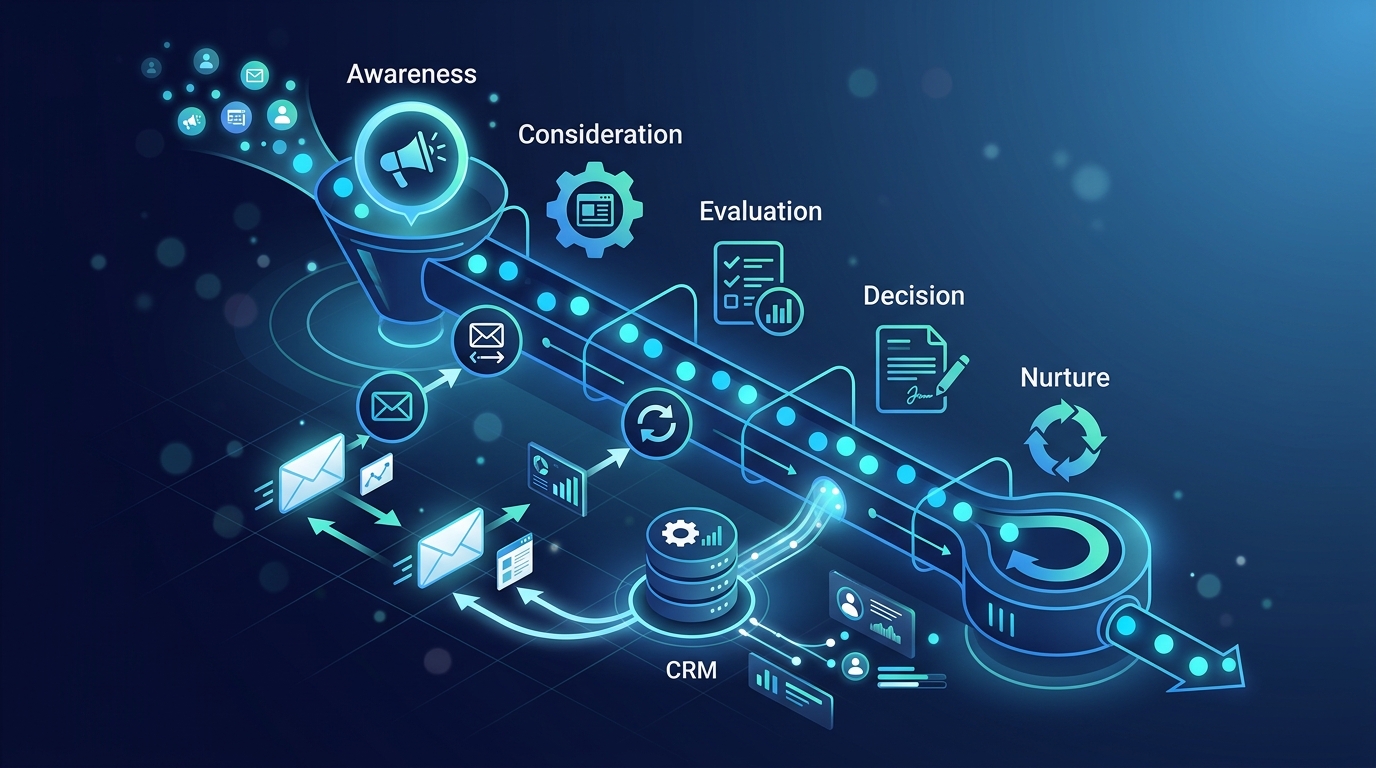
Most B2B sales funnels don't fail at the top. They fail in the middle — specifically, at the follow-up stage that happens after a prospect expresses interest and before they're ready to buy. This is the zone where deals quietly die, not because the prospect said no, but because nobody followed up at the right time with the right message.
For SMB founders running their own sales process, the math is brutal. You're busy. You meet someone at a conference, have a great intro call, send a proposal — and then three other things catch fire. The prospect doesn't hear from you for two weeks. By the time you circle back, they've either moved on or gone with a competitor who stayed in front of them.
Marketing automation doesn't replace the relationship. It replaces the forgetting.
Where B2B Funnels Actually Leak
The typical B2B funnel has five stages: awareness, interest, consideration, intent, and decision. Most SMB founders invest heavily in awareness (content, ads, social) and decision (closing calls, proposals), and neglect everything in between. Here's where the leaks happen:
Stage 2 → 3 (Interest to Consideration): A prospect downloads your lead magnet, watches your webinar, or replies to a cold email. You mentally tag them as "warm" and plan to follow up — but the follow-up either never happens or arrives too late to capitalize on the moment of interest.
Stage 3 → 4 (Consideration to Intent): A prospect visits your pricing page three times, reads two case studies, and doesn't book a call. This is the clearest buying signal in B2B, and most founders never know it happened because they're not tracking engagement at this level.
Stage 4 → 5 (Intent to Decision): A prospect books a call, gets a proposal, and then goes quiet. The typical SMB response is one or two follow-up emails. Research consistently shows that 80% of B2B sales require 5+ follow-up touchpoints. Most SMBs give up after two.
These aren't strategy problems. They're execution problems. And execution problems are exactly what automation solves.
What Marketing Automation Actually Does for B2B Sales
Marketing automation in a B2B context is not email blasting. It's trigger-based communication — the right message delivered automatically when a prospect takes a specific action or reaches a specific threshold of engagement.
Here's what a properly automated B2B funnel looks like:
Lead capture: A prospect fills out a form, requests a resource, or responds to outreach. They're automatically added to a CRM pipeline with a tag indicating their source and interest area.
Immediate engagement: Within minutes, an automated email goes out — not a generic newsletter, but a targeted message relevant to the specific action they took. The prospect experiences responsiveness even if the founder is asleep.
Nurture sequence: Over the next 2–3 weeks, a sequence of 4–6 emails delivers case studies, addresses common objections, and progressively builds the case for a discovery call. Each email is triggered by timing or behavior (opens, clicks, page visits).
Sales handoff trigger: When a prospect hits a defined engagement threshold — visits the pricing page, clicks the "Book a Call" CTA, or opens 3+ emails — the CRM flags them as sales-ready and the founder gets a notification. No more guessing who to prioritize.
Post-proposal follow-up: After a proposal is sent, a 3-email sequence goes out at Day 2, Day 5, and Day 10 if the prospect hasn't responded. Each email takes a different angle — value reinforcement, addressing a specific objection, creating urgency with a deadline or bonus.
This infrastructure doesn't require a marketing operations team. It requires setup, a stack, and consistent execution — which is exactly what an AI marketing agent delivers.
The Follow-Up Gap in Numbers
| Follow-up scenario | Typical SMB outcome | With automation |
|---|---|---|
| Prospect goes quiet after proposal | 1–2 follow-ups, then dropped | 5-touch sequence over 14 days |
| Warm lead from content download | Added to "someday" list, forgotten | Immediate nurture sequence triggered |
| LinkedIn connection who showed interest | Manual DM if remembered | Automated outreach at Day 1, 3, 7 |
| Cold prospect who opened 4 emails | Unknown — no tracking | Flagged as hot, personal follow-up triggered |
The pattern is consistent: manual processes create gaps, and gaps kill deals. Automation eliminates the gaps without requiring the founder to become a CRM power user.
Why SMBs Don't Automate — and Why That's Changing
There are three reasons SMB founders haven't automated their B2B funnels: cost, complexity, and time to setup.
Cost: Enterprise marketing automation platforms (HubSpot, Marketo, Pardot) start at $800–$3,000/month. For a founder doing $500K/year in revenue, that's 5–7% of revenue going to a tool before you've paid anyone to run it. The ROI math only works at scale.
Complexity: Setting up a proper automation stack — email platform, CRM, behavior tracking, sequence builder, integration layer — requires marketing operations expertise that most SMB founders don't have and can't afford to hire.
Time: Even if cost weren't an issue, configuring a 6-email sequence, mapping trigger conditions, writing the copy, and connecting everything to a CRM takes 20–40 hours. For a founder already stretched thin, that investment never makes it to the top of the priority list.
This is exactly where AI marketing agents change the equation. AgentGrow's Growth plan at $999/month includes the full B2B automation stack — CRM pipeline, trigger-based email sequences, engagement tracking, and autonomous follow-up execution — without the setup complexity or the operations overhead. The agent configures and runs the system; the founder reviews dashboards and handles discovery calls.
The ROI Frame Every B2B Founder Needs
If your average B2B deal is worth $5,000–$50,000, recovering even one deal per month that would have died in the follow-up gap changes the economics entirely.
That's not a marketing story. That's a revenue recovery story. And it's the clearest ROI case for marketing automation in B2B: you're not buying impressions or engagement — you're buying closed deals that would otherwise have fallen through the cracks.
What an Automated B2B Funnel Looks Like in Practice
For a B2B consulting firm running on AgentGrow, a typical week in the sales funnel looks like this:
- Monday: 4 new leads from blog content and LinkedIn posts automatically added to CRM with enriched data (company size, industry, engagement source)
- Tuesday: Automated Day 3 follow-ups go out to 7 prospects who received initial outreach on Saturday — personalized by industry vertical, referencing their specific pain points
- Wednesday: CRM flags 2 prospects as "hot" based on email opens and pricing page visits — founder gets a Telegram notification to reach out personally
- Thursday: Post-proposal sequence sends second follow-up to a prospect who received a proposal on Tuesday and hasn't responded
- Friday: Weekly pipeline report generated automatically — lead count, email open rates, sequence completion rates, and active opportunities by stage
The founder's involvement: reviewing the Telegram notifications for hot leads and handling the two discovery calls that were booked. Total active sales time: roughly 3 hours. Everything else ran on autopilot.
The Compounding Effect of a Never-Dropping Ball
The less-obvious benefit of automating your B2B funnel isn't just the deals you close. It's the reputation you build. When prospects consistently receive timely, relevant follow-ups — whether they're a new lead or a proposal that's been sitting for two weeks — they experience you as responsive and organized. That perception compounds.
In B2B services, buyers are choosing a partner, not just a product. How a founder handles the pre-sale process is a direct signal of how they'll handle delivery. Consistent follow-up, relevant nurture content, and a clear proposal process communicate operational rigor. The AI agent doesn't just close deals — it signals the quality of the firm that's deploying it.
Start with the leaks. Map your funnel, identify the stage where prospects go quiet most often, and build automation around that specific handoff. For most SMBs, that's the proposal follow-up or the warm-lead nurture sequence. Fix those two stages first, measure the change in conversion rate over 60 days, and then expand the automation from there.
The compounding starts when you stop dropping the ball. And you stop dropping the ball when the ball never depends on your bandwidth to stay in the air.