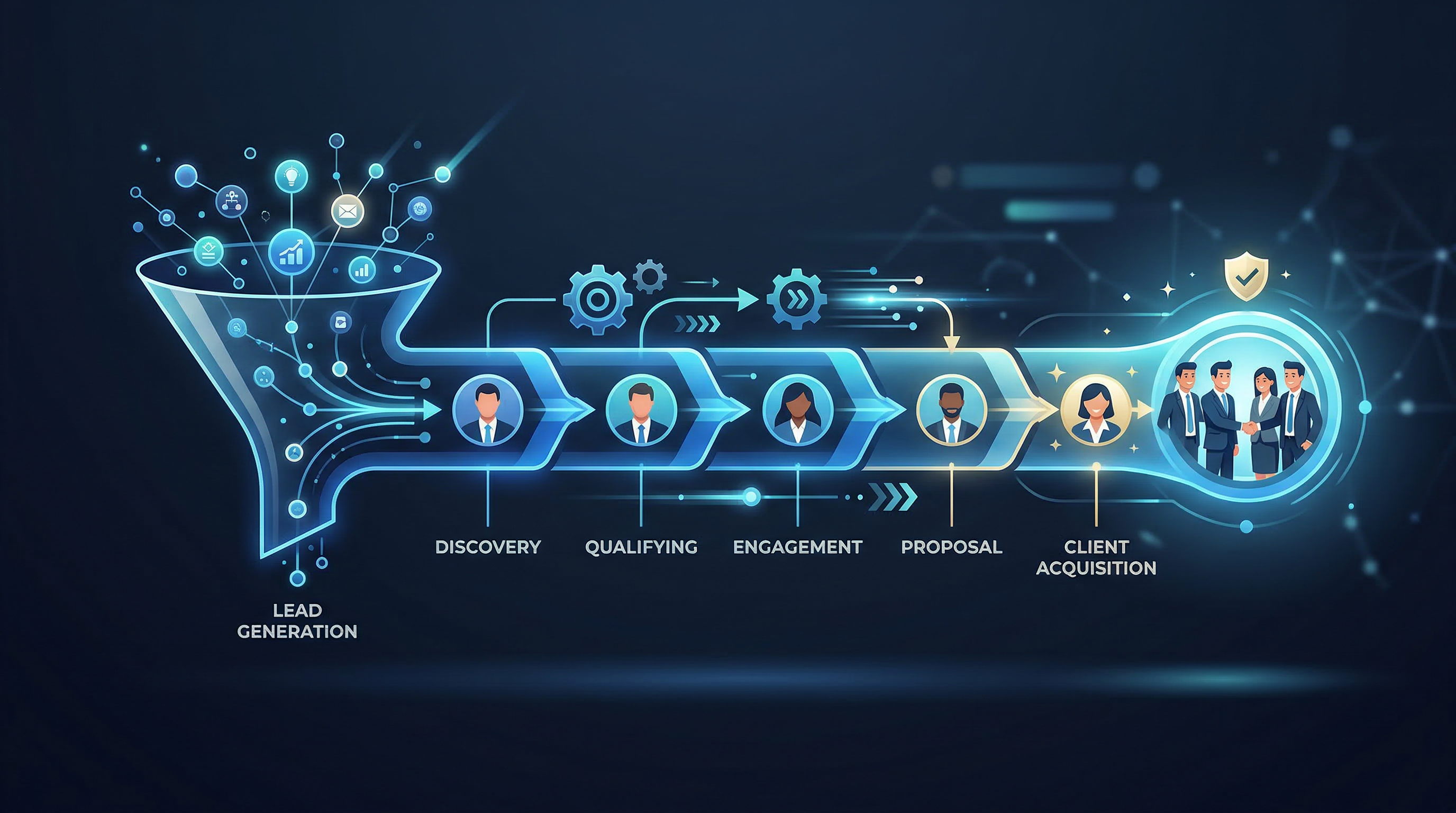
Key Takeaway: Coaches and consultants who build a three-channel lead generation system — SEO content, LinkedIn, and cold email — consistently outperform those who rely on referrals alone. The difference is not talent. It is systematised, always-on outreach.
If you are a coach or consultant reading this, there is a 70% chance your pipeline looks like this: a handful of strong client relationships, a referral that arrives every few weeks if you are lucky, and a nagging anxiety every time a project wraps up that you wonder where the next one is coming from.
You know you need to market. You just do not have time to do it consistently, a team to execute it, or a system that ties everything together. So you post on LinkedIn when inspiration strikes, respond to the occasional inbound inquiry, and hope the referral network holds.
It is a precarious way to run a business. And it is completely fixable — without hiring a sales team.
The Referral Trap Most Consultants Fall Into
Referrals are the best leads you will ever get. They arrive pre-qualified, carry built-in trust, and close faster than any cold outreach. The problem is not the quality of referral leads. The problem is the quantity — and the predictability.
Referrals follow a network effect: they come in clusters (when you finish a big project and the client talks to peers) and dry up in troughs (when you are heads-down delivering). The feast-or-famine cycle that plagues most consultants is directly caused by this single-channel dependency.
A 2025 survey of independent B2B consultants found that 68% cited "unpredictable pipeline" as their number-one business risk — above pricing pressure, client churn, and competition. Most of them knew what was causing it. Almost none had fixed it.
The solution is not to stop relying on referrals. It is to add channels that fill the gaps — specifically, channels that produce leads even when you are delivering for existing clients and have no time to actively prospect.
The Three-Channel System That Actually Works
Through working with hundreds of consultants and coaching businesses, we have seen the same three-channel combination consistently produce a full pipeline — regardless of niche:
- SEO content — long-form articles that rank on Google for the keywords your ideal clients search
- LinkedIn publishing — a consistent posting cadence that builds visibility and trust with your target audience
- Cold email outreach — targeted, personalised emails to verified lists of decision-makers in your ICP
None of these are new ideas. What makes them work together is consistency and automation — running all three simultaneously, every week, without manual effort piling up on your calendar.
Channel 1 — SEO Content That Attracts Ideal Clients
Your ideal clients are searching Google right now for answers to problems you solve. If your website does not appear in those results, a competitor's does.
B2B SEO for coaches and consultants is less about chasing high-volume keywords and more about owning specific, intent-rich phrases that signal buying readiness. The keywords that work best fall into three categories:
Problem-aware keywords — phrases your ICP types when frustrated: "how to get more B2B clients as a consultant," "why my consulting pipeline keeps drying up," "inconsistent revenue independent consultant."
Solution-aware keywords — phrases typed when researching options: "B2B lead generation for coaches," "consulting pipeline automation software," "best CRM for independent consultants."
Comparison keywords — phrases typed before purchasing: "HubSpot vs ActiveCampaign for consultants," "agency vs freelance marketing for coaching business."
Each blog post you publish on a targeted keyword is a permanent asset that generates traffic 24/7. A consultant who publishes two SEO-optimised posts per month will have 24 ranking articles at the end of the year — each one attracting inbound leads without additional spend.
The compounding math is significant. Pages that rank in positions 1-3 on Google receive 28-36% of all clicks for that keyword. For a keyword with 500 monthly searches, that is 140-180 visitors per month from a single page — indefinitely.
What most consultants do wrong: They publish blog posts about their methodology, their journey, or their opinion on industry trends. None of this ranks. Ranking requires targeting specific search phrases and structuring your content to answer those queries directly.
Channel 2 — LinkedIn Publishing That Builds Pipeline
LinkedIn is the highest-ROI social platform for B2B coaches and consultants, by a significant margin. It is where your prospects go to think about business, follow peers, and consume ideas — which means content that resonates there generates discovery, trust, and inbound DMs.
The LinkedIn algorithm rewards consistency over virality. An account that publishes four times per week for three months outperforms one that posts ten times in a week and then goes dark for six weeks. The accounts that consistently generate leads on LinkedIn share these characteristics:
- Post frequency: 3-5 times per week, minimum. The algorithm penalises inactivity with reduced distribution.
- Content mix: Insight (what you know) + Story (how you learned it) + Data (proof it is true) + Question (to drive comments)
- Hook-first structure: The first two lines must stop the scroll. Lead with a counterintuitive claim, a specific number, or a direct challenge to a common assumption.
- ICP targeting in the post itself: Write directly to a specific person — "If you are a B2B consultant billing over $10K/month," not "if you are in business."
The network effect compounds over time. At 500 followers, each post reaches roughly 800-1,200 people. At 2,000 followers, each post reaches 4,000-8,000. The consultants who feel like LinkedIn "suddenly started working" after 6 months are experiencing this compounding — they just had to survive the slow early phase.
Engagement is the signal: When you post about a prospect's specific pain ("why your consulting pipeline dries up every Q1"), the people who comment or react are self-identifying as having that problem. They are warm leads who have never spoken to you.
Channel 3 — Cold Email Outreach That Gets Replies
Cold email is the fastest channel to produce leads when done correctly. A consultant with a verified list of 200 ICP contacts and a well-written outreach sequence can have conversations booked within two weeks of starting.
The formula that works in 2026 is simple — but precise:
- Verify every email address before sending. A bounce rate above 3% damages your domain reputation and will cause Gmail and Outlook to filter your future emails to spam. Use an email verification service on every list before sending a single email.
- Write the first line about them, not you. Reference a specific detail about the company — recent funding, a job posting that signals growth, an article they published. Generic openers kill response rates.
- Name one specific pain. Not five. One. "I noticed you have been hiring for a marketing manager for four months. That usually means either you cannot find the right person or you are not sure what the role should do." This opens a conversation without selling.
- One clear CTA. Not "let me know if you are interested." A specific question: "Would it be worth a 20-minute call this week to see if we can shortcut the hiring process?"
- Follow up twice. Day 3 and day 7. Most replies come from follow-ups, not the first email. Stopping after one email means leaving 60-70% of potential responses on the table.
At a 5-8% reply rate (the industry benchmark for well-targeted, personalised outreach), 200 emails per week produces 10-16 conversations per week. At a 20% conversion rate from conversation to discovery call booked, that is 2-3 new opportunities every week entering your pipeline — consistently.
Automating Follow-Up Without Feeling Robotic
The biggest time drain in any outbound system is follow-up. Manually tracking who has been emailed, when to send the second message, and what to say feels like a full-time job when you are managing more than 50 active prospects at once.
Automation solves this completely — when done right. The key is personalising the first email (where the effort counts) and automating the timing and delivery of follow-ups (where consistency matters, not originality).
An effective follow-up sequence for consultants looks like this:
- Day 0: Personalised first email (reference a specific detail about them)
- Day 3: Brief follow-up adding a piece of value — a relevant case study, a data point, a resource they would find useful
- Day 7: Final short email acknowledging the timing may not be right and opening the door for a future conversation
This three-email sequence, automated to run on schedule without manual intervention, keeps your name visible through the full decision window without requiring daily attention.
The CRM Layer: Turning Prospects Into Clients
Most consultants lose deals not because the prospect was not interested — but because follow-up fell through the cracks. The prospect replied with "send me more details," the consultant got busy with client work, and the conversation went cold.
A CRM solves this with pipeline visibility and follow-up triggers. You need to see, at a glance: who is in the pipeline, what stage they are at, when the last touchpoint happened, and what the next action is.
For a solo consultant or small consultancy, the key CRM fields are:
- Company and contact name
- Lead source (how they found you)
- Current pipeline stage (Discovery / Proposal / Negotiation / Closed)
- Last contact date
- Next action and due date
- Deal value (estimated monthly or project revenue)
With this data, you can see in 30 seconds that three proposals have been sitting for two weeks with no follow-up, and act immediately. Without it, those three deals simply go cold and you never know why.
Running It All Without a Sales Team
Here is the obvious objection: running SEO content, LinkedIn, and cold email simultaneously sounds like a full-time marketing job — plus a sales job on top of it. And it was, until recently.
AI changes the math dramatically. An autonomous AI agent can:
- Research and write SEO-optimised blog posts every week targeting specific keywords
- Draft and schedule LinkedIn content in your voice, on your posting cadence, without manual effort
- Build prospect lists from verified sources, personalise outreach emails at scale, and run follow-up sequences automatically
- Track pipeline in a CRM and surface who needs a follow-up today
- Analyse what is working (which email subjects get replies, which LinkedIn posts get engagement) and adjust strategy automatically
This is not theoretical. AgentGrow clients running a dedicated AI CBO agent are maintaining three-to-five weekly touchpoints across all channels with zero marketing headcount. The agent does the execution. The consultant does the delivery and the closing.
One AgentGrow client — a solo IT consulting firm — went from 0 to 346 qualified leads in their CRM in 19 days, with 18 blog posts published, 100+ social posts distributed across LinkedIn and Facebook, and 185 outreach emails sent with no bounces. No marketing hire. No agency. Just an AI agent running the system.
The consultants who will win the next five years of B2B client acquisition are not the ones who hustle harder on referrals. They are the ones who build systems that generate leads while they sleep — and use AI to run those systems without a team.
Ready to build your consulting pipeline on autopilot?
AgentGrow deploys a dedicated AI agent that handles your content, outreach, and pipeline — so you can focus on client delivery.
Start Your Free 7-Day Trial →