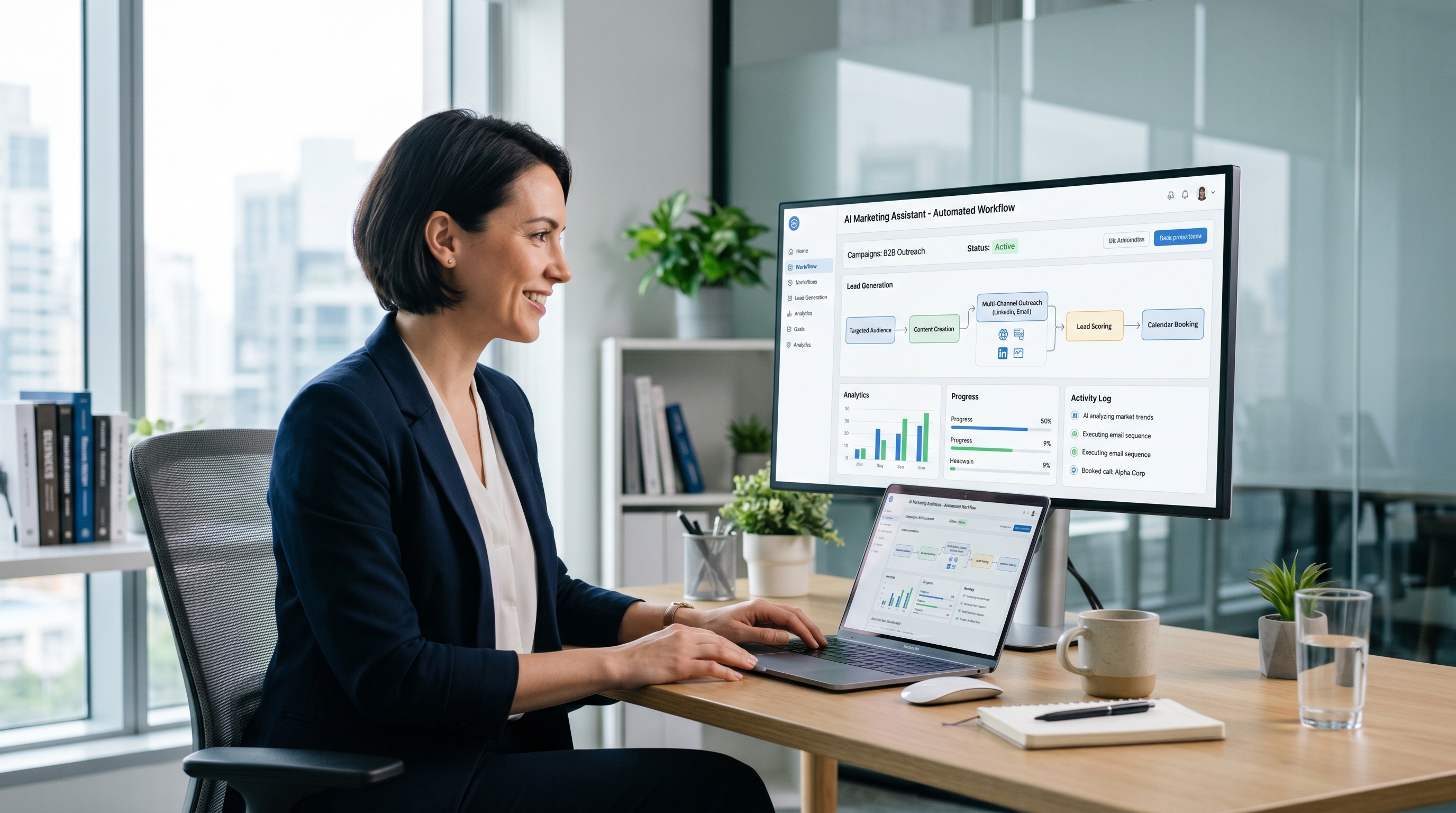
Most B2B service founders describe the same problem: they know their business needs more marketing, but every hour spent on it is an hour not spent doing the work that pays the bills. The gap between "should market more" and "actually has time to market" never closes on its own.
The answer that used to require a hire — a marketing manager, a content coordinator, a cold outreach assistant — is now available through an AI employee. Not a tool you babysit. Not a template you fill in. A dedicated, autonomous agent that runs your marketing while you focus on delivery.
This guide is for founders who want to understand what that actually looks like in practice — what an AI employee can do today, what it cannot do yet, and how to evaluate whether it is the right fit for your business.
What Is an AI Employee?
The phrase gets used loosely, so let us be precise. An AI employee is an autonomous agent configured to handle a specific business function — marketing, sales prospecting, content creation, follow-up sequences — without requiring you to approve every action.
Unlike a simple chatbot or a keyword-scraping tool, an AI employee maintains context across a campaign. It knows your ICP (Ideal Customer Profile). It remembers which prospects you have contacted, which ones replied, and which follow-ups are due. It adapts its approach based on what is working.
The AgentGrow platform runs AI employees across a Kubernetes cluster — each agent handles a specific channel or function. The platform includes built-in quality gates, approval workflows, and CRM synchronization. You get the autonomy of an employee with the consistency of software.
For B2B service founders in India — IT consultants, management advisors, digital agencies, CA firms — the typical use case involves three areas: lead generation, outbound prospecting, and content marketing. Let us look at each.
Lead Generation: Running Without a Prospecting Team
The most common bottleneck for a growing B2B service business is pipeline. You have capacity to take on more clients, but you do not have enough qualified leads coming in to fill that capacity. The instinct is to hire a business development person. But BD persons are expensive, require management, and often have a ramp-up period of three to six months before they generate meaningful results.
An AI employee configured for lead generation can do the following, autonomously:
- Search LinkedIn and Google Maps for companies matching your ICP — geographic location, company size, industry keywords, technology stack
- Enrich those company profiles with decision-maker contact data: name, title, LinkedIn URL, email pattern
- Score prospects against your qualification criteria — company size, revenue range, hiring signals, technology adoption
- Populate your CRM with leads, interactions, and lead scores — no manual data entry required
The AI employee does not just collect names. It applies judgment. A founder in Pune running an IT consulting practice had their AI employee filter 300+ prospect companies down to 47 that matched their real ICP — based on company size, tech stack (they specialize in SAP implementations), and geographic focus. The founder reviewed the shortlist in under an hour and started outreach immediately.
This is the practical difference between "we need more leads" and actually having a pipeline you can act on.
Outbound Prospecting: Cold Outreach at Scale, Done Right
Outbound is where most founders either over-invest (spending hours writing one-off emails) or under-invest (sending generic templates that do not convert). The AI employee changes the economics by making personalization scalable.
Here is how it works in practice on the AgentGrow platform:
The agent starts with your Ideal Customer Profile — which you have defined once, not per campaign. It researches each individual prospect using public sources (LinkedIn, company websites, news mentions) and generates a personalized outreach sequence. Each email references something specific about the prospect's business: a recent hire, a technology initiative, a growth milestone.
The sequence runs over multiple touchpoints: initial cold email, follow-up on day three, LinkedIn connect on day five, second email on day seven. Every touchpoint is customized, not templated. And the agent tracks replies — so when someone responds, it flags the conversation for you to take over with full context.
Typical B2B service founders running this approach see open rates 2–3x higher than blast campaigns, simply because the content is genuinely relevant to each recipient. The agent handles the research and drafting; you handle the relationship.
"The AI employee does not send emails for you — it makes you look like you spent three hours on every email when you actually spent three minutes reviewing the output."
The key constraint to understand: the AI employee handles prospecting, not closing. It fills the pipeline. You or your sales team close the deals. That is a feature, not a limitation — it means the agent never drops a lead, never forgets to follow up, and never gets distracted by an inbound enquiry that derails outbound priorities.
Content Marketing: Consistent Output Without a Content Team
Content is the long game in B2B service marketing. The founders who win at inbound typically publish consistently for 12 to 18 months before seeing compounding results. But most founders cannot sustain that pace — they write two posts, miss a month, write one more, get busy, and the blog becomes an orphan asset that makes the website look stale rather than active.
An AI employee can maintain your content calendar autonomously:
- Research and write 2–4 long-form blog posts per month targeting specific keywords and ICP pain points
- Repurpose each post into LinkedIn posts, email newsletter content, and short-form video scripts
- Schedule and publish to your blog and LinkedIn profile without manual intervention
- Track which topics drive the most inbound leads and optimize the content calendar accordingly
The quality question is real here, and it is worth addressing directly. AI-generated content, run through a proper quality gate with human review, is sufficient for B2B decision-makers who are researching solutions. The bar is not "sounds like a robot wrote it." The bar is "solves a problem I am searching for and demonstrates credible expertise." Content that clears that bar drives pipeline, regardless of whether a human or an AI drafted the first version.
On the AgentGrow platform, every content piece goes through a quality gate before publishing. You get a review notification, not just an auto-publish. That is deliberate — your reputation with prospects is the asset being protected.
With 5,000+ professionals trained and an Oracle rating of 4.91 out of 5, the AgentGrow approach to content automation has been refined across hundreds of B2B marketing campaigns. The platform handles the production pipeline; you provide the strategic input — what problems your clients face, what your differentiated offer is — and the AI employee translates that into a consistent content presence.
Evaluating Whether an AI Employee Is Right for You
Not every B2B service business is ready for a fully autonomous AI employee. The decision comes down to three factors:
1. Do you have a clear ICP? The AI employee applies judgment against a target profile. If you cannot articulate who you are targeting and why, the agent will not be able to either. ICP definition is a prerequisite, not an optional input.
2. Is your service offering stable? AI employees are very good at executing repetitive processes consistently. If you are still iterating on your service menu, your pricing, or your target market, you may want to nail those fundamentals before automating the marketing around them.
3. Can you review and approve content? Even with a fully autonomous agent, you remain the face of the business. That means reviewing the output — emails, blog posts, social content — before they go out. The time commitment is minimal (typically 15–30 minutes per week), but you cannot skip it entirely if the brand voice matters to your sales process.
If all three check out, the ROI case is straightforward. A part-time BD person costs ₹25,000–₹50,000 per month in India with limited output. An AI employee on the AgentGrow platform handles 3–5x the outreach volume with consistent quality and no management overhead. The economics improve further as the agent learns from your feedback and sharpens its targeting over time.
The 2026 reality is that the founders who are growing their B2B service businesses fastest are the ones who have effectively doubled their team size — without adding headcount. An AI employee does not take holidays, does not have bad weeks, and does not forget to follow up on a promising prospect because a client deliverable took priority.
Getting Started: The First 30 Days
If you are ready to deploy an AI employee, here is a realistic timeline for the first month:
Week 1 — Setup and ICP definition. Define your Ideal Customer Profile with specific criteria: company size, industry, geography, decision-maker titles, buying signals. Configure the agent with your service offerings, competitive positioning, and key messaging themes. This is the highest-effort step but also the most important — the quality of the setup determines the quality of everything that follows.
Week 2 — Prospecting pipeline build. The AI employee begins identifying and enriching prospects matching your ICP. You review the first shortlist and provide feedback on qualification criteria. The agent learns from your corrections.
Week 3 — First outreach campaign. The agent launches a personalized cold outreach sequence to your first prospect cohort. You review outgoing emails and approve the campaign before it goes live. Replies start coming in by end of week.
Week 4 — Content calendar activation. The AI employee publishes your first blog post (after your approval) and repurposes it across LinkedIn and your email list. You track engagement metrics and identify which topics resonate most with your audience.
By the end of 30 days, you have a live marketing operation running in parallel with your client work — with minimal time investment from you beyond strategic direction and content review.
Most founders who deploy an AI employee tell us the same thing: "I wish I had done this a year ago." The constraint is not whether the technology works — it does. The constraint is the decision to stop managing marketing manually and start running it systematically.
The AI employee for B2B service businesses is not a hypothetical future. It is available today, it is proven across thousands of campaigns, and it starts delivering from week one. The only question is whether you are ready to make the shift.
Use code FIRST10 to get started — that is 10% off your first month on the AgentGrow platform, which includes full access to the AI employee suite, CRM integration, and 119 hands-on labs for platform mastery.
AgentGrow helps B2B service founders build production-ready AI agents in five days. With 25+ years of enterprise engineering experience across JPMorgan Chase, Deutsche Bank, and Morgan Stanley, our platform is designed for founders who need real marketing automation — not another generic SaaS tool.