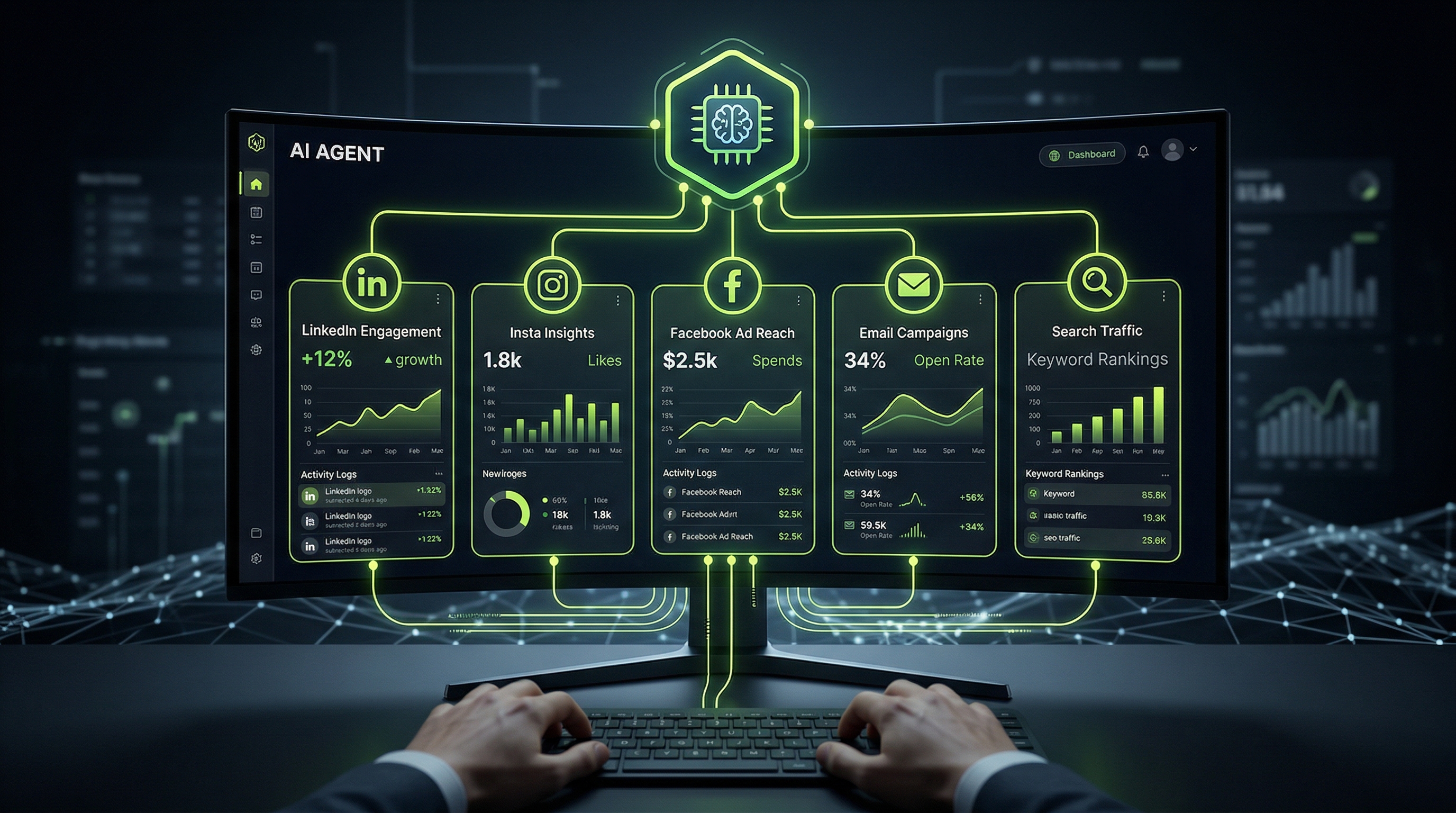
Most SMB founders know they should be active on LinkedIn, posting to Instagram, running Facebook campaigns, sending emails, and publishing SEO content. The problem is never awareness — it is capacity. Each channel demands different formats, different timing, and different strategy. That is why most businesses pick one or two channels and neglect the rest.
An AI CBO agent changes this equation entirely. Instead of hiring five specialists or one overwhelmed generalist, a single autonomous agent runs all channels in parallel.
The Multi-Channel Problem for SMBs
Here is what running five marketing channels actually looks like for a small team:
- LinkedIn: 3-5 thought leadership posts per week, engagement with comments, connection requests, DM outreach
- Instagram: Daily feed posts, Reels 2-3x per week, Stories, hashtag research, comment management
- Facebook: Page posts, ad campaign management, lead form monitoring, community engagement
- Email: Cold outreach sequences, drip campaigns, follow-ups, list hygiene
- SEO: Blog posts 2-4x per month, keyword research, technical audits, backlink building
Conservatively, that is 25-30 hours per week of focused marketing work. At a $50/hour blended rate for a marketing coordinator, you are looking at $5,000-$6,000 per month — before tools, ad spend, or management overhead.
How an AI Agent Runs All Five Channels
An AI CBO like AgentGrow does not context-switch. It runs parallel workflows across every channel simultaneously:
1. Content Creation and Repurposing
The agent writes a long-form blog post optimized for SEO. It then automatically repurposes that post into a LinkedIn article, an Instagram carousel caption, a Facebook post, and an email newsletter segment. One piece of content becomes five channel-specific assets — without anyone copying and pasting.
2. Scheduling and Timing Optimization
Each channel has different optimal posting times. The agent maintains independent queues for each platform and publishes at the right intervals — every 6 hours for social, once daily for Reels, weekly for email sequences. No human needs to remember or manage the calendar.
3. Lead Pipeline Integration
When a Facebook ad generates a lead, the agent automatically enters them into the CRM, sends a personalized cold email based on their pain point, and schedules follow-ups on day 3 and day 7. The lead does not sit in a spreadsheet waiting for someone to notice it.
4. Performance Monitoring
The agent checks ad performance daily. If an ad's CTR drops below threshold, it pauses automatically. If a blog post ranks on page 2 for a valuable keyword, the agent flags it for content optimization. No weekly reporting meetings needed — the agent acts on data in real time.
Real Numbers: What This Looks Like in Practice
Here is what an AgentGrow deployment typically produces in its first 30 days:
| Channel | Output |
|---|---|
| Blog posts (SEO) | 8-12 long-form articles |
| LinkedIn posts | 20-30 posts (personal + company page) |
| Instagram posts | 25-30 feed posts + 15 Reels |
| Facebook posts | 25-30 posts + ad management |
| Email sequences | 50-100 personalized outreach emails |
| Leads generated | 50-150 qualified leads |
That is the equivalent output of a 3-person marketing team — for $499 per month.
Why Not Just Use Scheduling Tools?
Tools like Buffer, Hootsuite, or HubSpot can schedule posts. But they do not create content, respond to performance data, manage lead pipelines, or adapt strategy based on what is working. They are dashboards. An AI CBO is an operator.
The difference is like comparing a spreadsheet to a CFO. Both deal with numbers. Only one makes decisions.
Getting Started
If you are spending more than 10 hours a week on marketing — or worse, not doing it at all because you do not have time — an AI CBO can take over all five channels within 48 hours of setup.